
These are the 100 poems behind karuta — the card game from the anime Chihayafuru — chosen near Kyoto over 800 years ago, and still memorized by children across Japan today. This is one of them.
What is Hyakunin Isshu? Read the full guide
The poem
あしびきの 山鳥の尾の しだり尾の ながながし夜を ひとりかも寝む
Romaji: Ashibiki no / yamadori no o no / shidari o no / naganagashi yo o / hitori kamo nen
Long as the trailing tail of the mountain pheasant
drooping down the slope —
must I sleep through this long, long night alone?
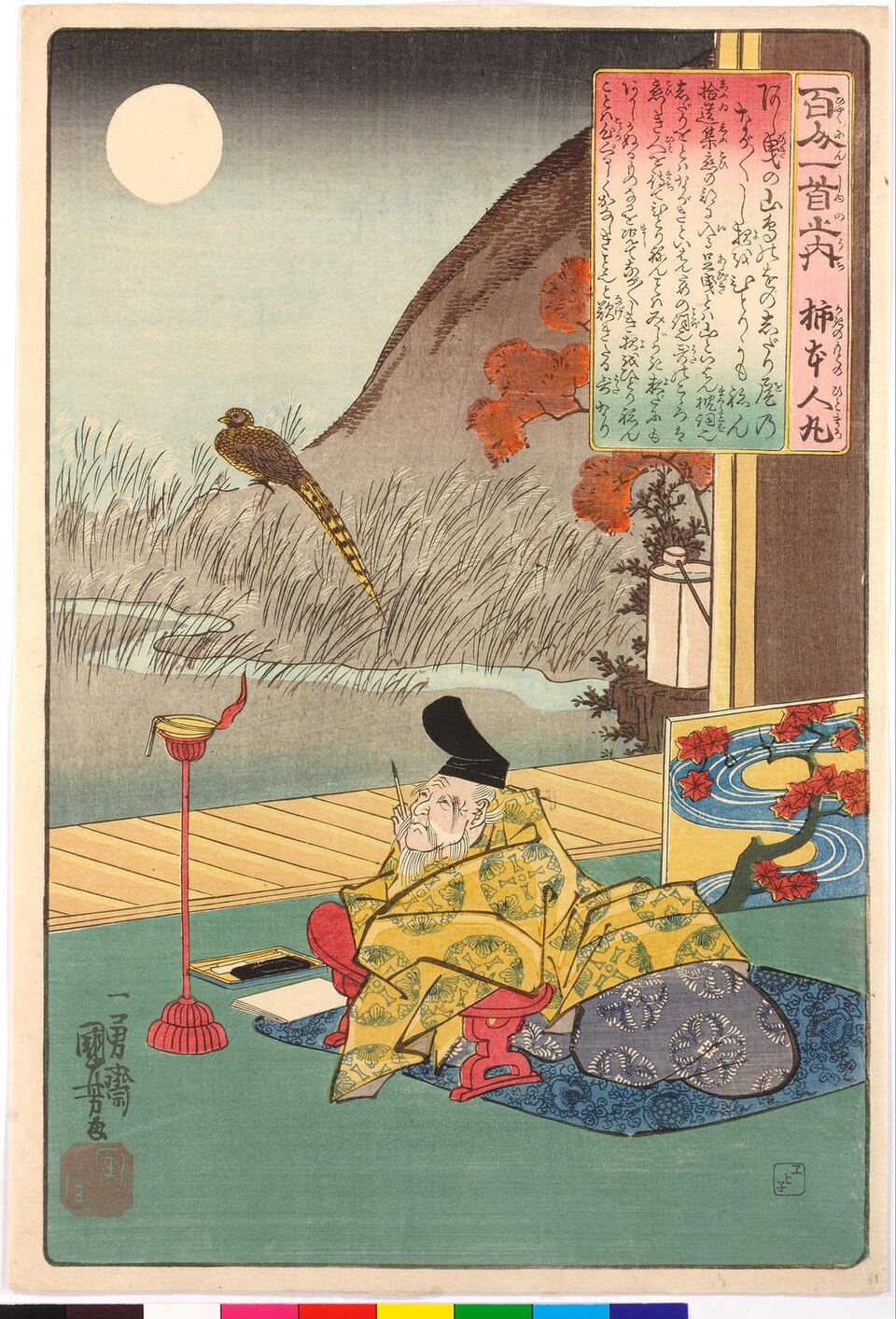
Who was Kakinomoto no Hitomaro?
Hitomaro lived around 1,300 years ago and is remembered as one of the greatest poets in all of Japanese history — so revered that later generations honored him almost as a god of poetry. To Japanese readers, his name carries the weight that Homer or Shakespeare carries in the West.
Meaning & background
This is a poem about loneliness, and its craft is breathtaking. To express how endless a night alone can feel, Hitomaro reaches for the long, drooping tail of a mountain pheasant — and there is an old belief that male and female pheasants sleep apart, on opposite sides of a ridge. So the very image chosen to measure the night’s length is itself an image of separation. The loneliness is in the meaning and hidden inside the metaphor. Thirteen centuries later, the ache still lands instantly — that is why it was chosen.
The commemorative medal
[ メダル画像をここに挿入 / alt: “Hyakunin Isshu Poem 3 Kakinomoto no Hitomaro commemorative brass medal” ]
Each poem in the Hyakunin Isshu is cast as a 31mm brass commemorative medal, struck by master craftsmen in Japan — the poem and the figure of its poet pressed into metal that will not fade.
View the full medal collection
Explore the series
Poem 2 (Empress Jitō) · Poem 4 (Yamabe no Akahito) · What is Hyakunin Isshu? Full guide