
These are the 100 poems behind karuta — the card game from the anime Chihayafuru — chosen near Kyoto over 800 years ago, and still memorized by children across Japan today. This is one of them.
What is Hyakunin Isshu? Read the full guide
The poem
春過ぎて 夏来にけらし 白妙の 衣ほすてふ 天の香具山
Romaji: Haru sugite / natsu kinikerashi / shirotae no / koromo hosu chō / ama no Kaguyama
Spring has passed, and summer seems to have come at last —
for they say the pure white robes are spread to dry
on heavenly Mount Kagu.
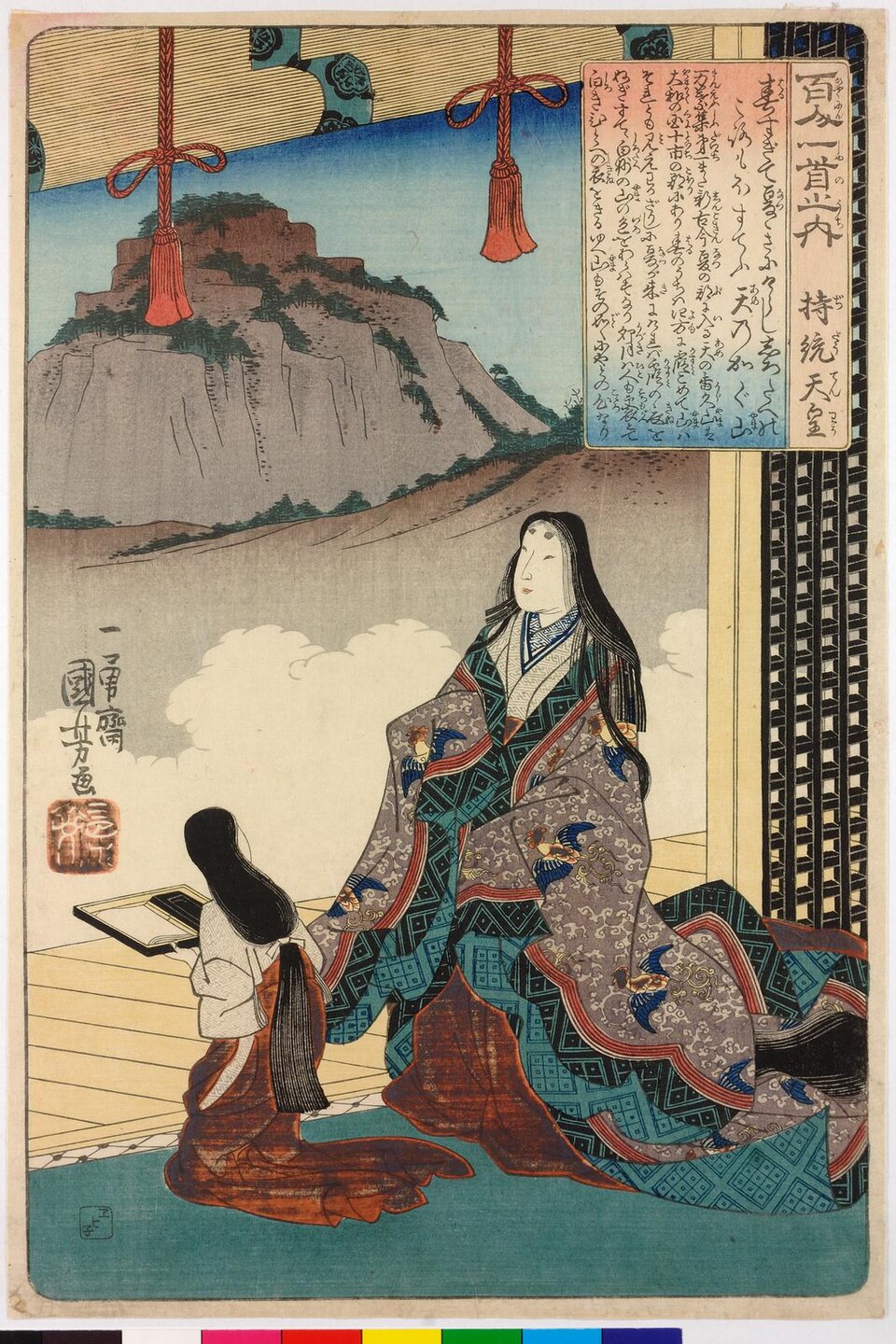
Who was Empress Jitō?
Empress Jitō reigned in the late 600s, one of the very few women ever to rule Japan in her own right. She governed an empire — and she wrote this. Stop and consider that for a moment: a head of state, more than 1,300 years ago, whose surviving words are not a decree or a war record, but a quiet, almost domestic observation of laundry drying on a hillside.
Meaning & background
The poem catches a single instant of seasonal change. The poet sees white summer robes laid out to dry against the green of Mount Kagu — a mountain considered sacred — and from that one image, knows that spring has slipped into summer. There is no drama here, and that is the point: 1,300 years ago, a ruler noticed the same small turning of the year that you might notice today, and found it worth preserving forever. That tiny, human act of attention is what has survived three empires, countless wars, and thirteen centuries.
The commemorative medal
[ メダル画像をここに挿入 / alt: “Hyakunin Isshu Poem 2 Empress Jito commemorative brass medal” ]
Each poem in the Hyakunin Isshu is cast as a 31mm brass commemorative medal, struck by master craftsmen in Japan — the poem and the figure of its poet pressed into metal that will not fade.
View the full medal collection
Explore the series
Poem 1 (Emperor Tenji) · Poem 3 (Kakinomoto no Hitomaro) · What is Hyakunin Isshu? Full guide