
These are the 100 poems behind karuta — the card game from the anime Chihayafuru — chosen near Kyoto over 800 years ago, and still memorized by children across Japan today. This is one of them.
What is Hyakunin Isshu? Read the full guide
The poem
田子の浦に うち出でて見れば 白妙の 富士の高嶺に 雪は降りつつ
Romaji: Tago no ura ni / uchiidete mireba / shirotae no / Fuji no takane ni / yuki wa furitsutsu
When I come out onto the shore of Tago Bay and look up —
there it is, pure white:
snow still falling on the high peak of Mount Fuji.
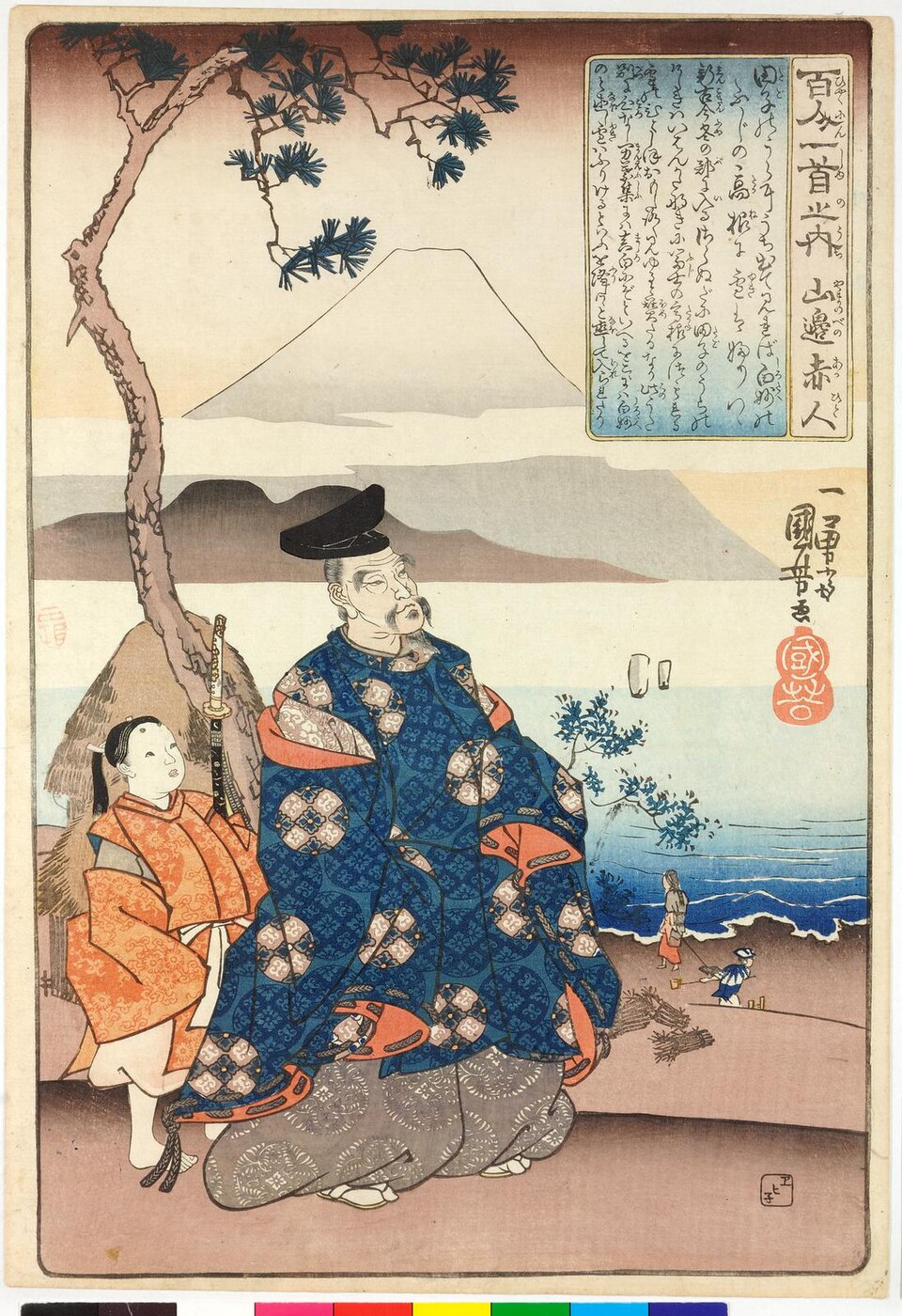
Who was Yamabe no Akahito?
Akahito was a court poet of the early 700s, celebrated above all for his nature poetry. Alongside Hitomaro, he is counted among the finest poets of Japan’s ancient age.
Meaning & background
If you are planning a trip to Japan, you have almost certainly seen photos of Mount Fuji — and you may be hoping to glimpse it yourself. So did this poet, around 1,300 years ago. He steps out onto the shore, looks up, and is stopped in his tracks by the same sight that stops travelers today: Fuji, impossibly white, snow falling on its summit. The wonder you feel at that mountain is not new. It is the same wonder, felt by a real person more than a millennium ago, and pressed into 31 syllables so perfectly that Japan has never let it go. Reading this poem before you see Fuji is like being handed a thousand-year-old postcard from someone who stood exactly where you will stand.
The commemorative medal
[ メダル画像をここに挿入 / alt: “Hyakunin Isshu Poem 4 Yamabe no Akahito Mount Fuji commemorative brass medal” ]
A traveler’s keepsake far more lasting than a photo. Each poem in the Hyakunin Isshu is cast as a 31mm brass commemorative medal, struck by master craftsmen in Japan — the poem and the figure of its poet pressed into metal that will not fade.
View the full medal collection
Explore the series
Poem 3 (Kakinomoto no Hitomaro) · Poem 5 (Sarumaru Dayū) · What is Hyakunin Isshu? Full guide